19.9.08

Arriving in New York..


Arriving in America properly was delayed by the zealousness of the US Immigration service who decided to send me into a small over crowded room to await review. From out flight there was only a black man with dreadlocks, a white guy who turned out to be an actuary and me. Most of the people in the room seemed to be older ladies from Eastern Europe who shared hairstyles and taste in clothes with my mother-in-law. My wife who retained the right to wait with me while I was reviewed said it was probably because in my passport photo I look a) very dark-skinned and b) more importantly, like a serious jihadist. I can kinda see what she means by the photo but I suspect it was the fumes from the unlikely cocktail of beer, wines red and white, bloody mary, beer and brandy that I unwittingly breathed all over the immigration lady while I was being electronically finger-printed that set the alarm bells ringing. The room reminded me most of the dole office in Birmingham where I used to sign on as a teenager. But here they had guns and were more smartly turned out. They seemed to really buy into the idea that they're protecting the homeland. Anyway, once they'd reviewed my case I was allowed to leave without questioning so I never found out what the problem was.
The thing that I noticed first is that Yellow taxis don't look like they used to - but it is 18 years since I last came to New York. Instead of the menacing death machines of Travis Bickle they look like a cab would in a Disney film.

Things done so far: ate in the diner round the corner (twice); hung out in Central Park (twice); Frick collection (twice - once to see in they had cafe only); tea from place on corner (twice); Bloomingdales; Pylones; walked around a lot.
I kept seeing the Frick in NY's best kept secret-type lists so it obviously isn't that much of a secret. It is an amazing collection amassed at the start of the 20th century by old man Frick (aka "The most hated man in America"). For your money ($15) you get an amazing Bellini, an amazing Duccio, Cimabue, a couple of very good El Grecos, two excellent Holbeins, a couple of Titians, a very nice Ingres, a great Velazquez and others I've forgotten.

10.9.08

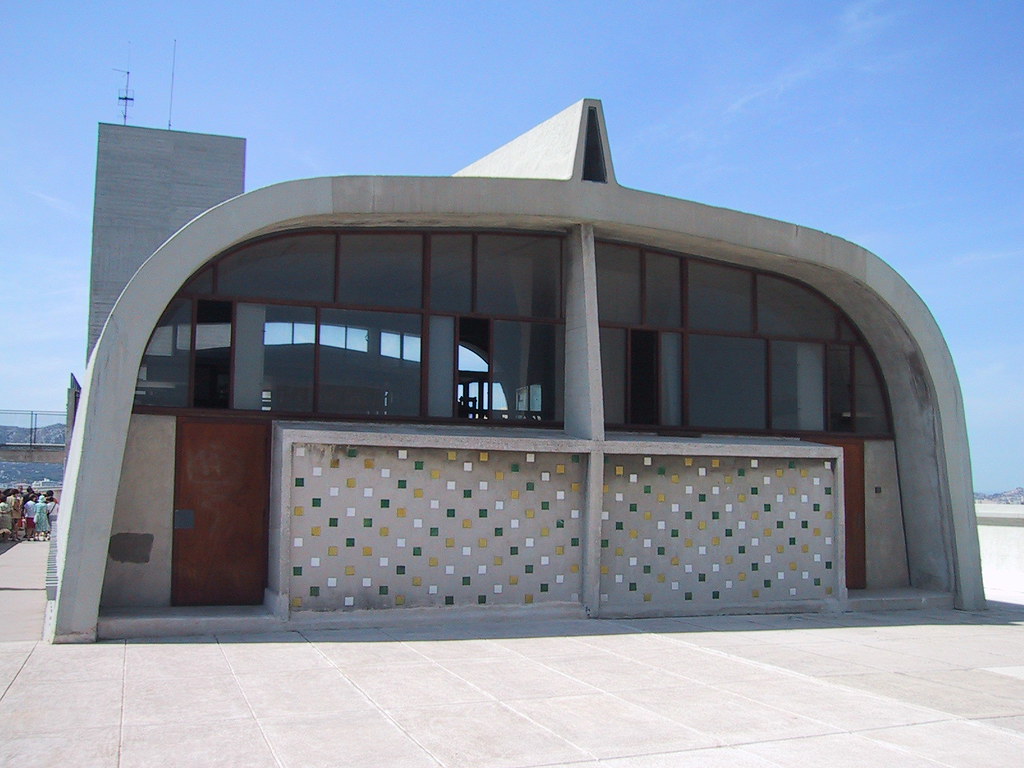
Unité d'Habitation, Marseille


This is part of a series of pictures of Le Corbusier's Unité d'Habitation in the south of France. I made my family visit Marseille specifically so I could go and see it. I first saw it in slides as an 18 year-old on an art history A level course in Birmingham. It's the sort of thing you don't forget. Years later I got to live in Trellick Tower for a year due to the kindness of Chris Collins. Not the same but not bad. Maybe tower blocks need sunshine to fully work.

8.9.08

George Bowbrick aka Warren Mitchell in The Saint


I was watching The Saint on itv.com as you do when you're writing the entire copy for a website that hasn't been built yet - maybe you don't but hey, I don't go around criticising your working methods - and came across a bit that made me go 'Fuck me' (as you do when you're watching old episodes of things with Roger Moore in). It was an episode called The Charitable Contessa and although set in Rome was patently shot in the same place as all the other epsiodes (somewhere in West London I suspect) and had a cast of kids and British actors playing Italians with duff accents. My favourite (so far, I'm only halfway through the ep) is Warren Mitchell playing an Italian taxi driver called Marco de Cesari. With a name like that he could also be the hero of a very steamy Mills and Boon. That's Warren in the picture above. But more than that my very first thought was 'Fuck me doesn't that Italian taxi driver look like Steve's dad'. Then I thought 'Oh. It's Warren Mitchell.' Anyway, I've been thinking about George (Steve's dad) because I'd been looking at pictures of his much belated funeral on Flickr recently. Anyway, I guess I'm writing this all here because for every story you ever told George he always had one to tell back at you.

This one's for George Bowbrick aka Warren Mitchell aka Marco de Cesari.

6.9.08

Richard Prince at the Serpentine

In keeping with tradition we go to see a show that's been on for months on the final weekend. I love Richard Prince but the show is disappointing. There isn't enough work for a start and what's in there is pretty patchy and tries to explain the Prince phenomena within the traditional language of art production, namely a selection of different pieces from different bodies of work. I saw some of the nurse paintings at Sadie Coles in 2003 as well as the earlier Publicities and one of the things that struck me is Prince isn't simply about appropriation but about serial appropriation. He doesn't just borrow something the once, he borrows it over and over again which makes the impact all the greater. Publicities in particular is for me an archetypal Prince show - he does almost nothing that sits in the realm of what we still think an artist does: he chooses some pictures from his own stash, has them framed and in a few cases embellishes them with (almost certainly faked) celebrity autographs. This isn't to say that there isn't an acceptable face to Richard Prince - he paints as well as anyone and there's a reassuring intelligence at work - it's just that this isn't the most interesting one.

31.8.08

Tates Modern and Britain: Street & Studio versus The Lure of the East


Typically, despite the fact that a walk down Vyner Street at this time of year reveals that most galleries are closed for the summer or in the hands of private hires, I still manage to miss or near miss the summer blockbusters I've been promising myself to go and see for the last three months.

Orientalism at Tate Britain promises much, largely inspired by the Edward Said connection implied by the title, and sadly doesn't deliver. The revelation for me on coming across a small oil on paper picture of Sarajevo from 1922 by Stanley Spencer in the very last room was that most of the stuff I'd been looking at before didn't have any great artistic merit. Even from an anthropological point of view the show doesn't engage. The imperialist values that seemingly imbue Orientalism have never really express themselves in the purely visual and the show struggles to get to the heart of the matter. The show opens with portraits of Victorian orientalists in arab outfits, the white boy wannabees of their day, moving through architectural studies of Cairo, a very disappointing room showing what the western imagination thought went on in the harem (dull) before petering out in the early twentieth century. The whole thing did make me wonder how things might have played out differently had there been no islamic prohibition on self-representation during the western explorations of the middle-east.

Street and Studio at Tate Modern which you've now officially missed is great because as well as the stuff you'd hope to see like Cartier-Bresson and Walker Evans the curatorial team have pulled out some seemingly slight but equally powerful pieces you're less likely to have seen. Coming a few days after my visit to Tate Britain Ed van der Elsken's five pictures of a Hong Kong woman again highlighted what was missing for me from the first show. What had appeared to be a set up sequence of a model in the crowds turns out to be way nastier. As Elsken's is quoted in this extract from the Tate gallery notes:
Ed van der Elsken’s tactics were more aggressively voyeuristic. He followed an anonymous woman around the streets of Hong Kong, creating a sequence of pictures that is reminiscent of a tracking shot from a movie. ‘I followed this babe around for a while. She knew I was doing it, and didn’t like it one bit’, he confessed.


Polish-born (but now based in Germany) Timm Rautert's 1974 sequence 'Germans in Uniforms' made me laugh as did Cindy Sherman's 'Bus Riders' from 1976. Sherman's reconstructed the look and poses of a series of people observed on the bus and taken self-portraits. For half the pictures she's blacked up and here's my drawing of one of these black bus riders. Here's my drawing from a sequence of anonymous street photos from 1960s Berlin where passers by posed with a man in a bear costume. I made a list of photographers/works to find out more about (some I'd never heard of):
Lewis Hine
Arnold Genthe's pictures of San Francisco's Chinatown
Martin Chambi
James van der Zee
Yva
Arturo Ghergo
Malick Sidibé (I never followed up last time from the Barbican show)
Laurie Anderson's 'Fully Automated Nikon [object/objection/objectivity], 1973 and the stuff it's inspired that's happening now.

Rght at the end of the show is Rineke Dijkstra's two screen video projection 'The Buzz Club, Liverpool, UK/Mystery World, Zaandam, NL' 1996-7 where young club-goers, much the worse for wear in several cases, dance in front of a white screen to a techno soundtrack that seems to be coming from an adjacent room. Larger than life on the wall it's a powerful piece about inhibition, control.

The Real Tuesday Weld at St Pancras Church, last Wednesday

There was a book launch or art show or something and the a band playing called The Real Tuesday Weld. We liked them a lot - they were laid back and looked like mature art students. I liked them because they didn't have to try too hard. They played in a corner of the crypt and it was very dark. There may be none of the band members in this picture but it's a good representation of the gig.

29.8.08

If you look hard you can see...

Me and Yol took Leon and Betty to the Grant Museum of Zoology which, as I tell anyone who'll listen, is one of my favourite places in London. We also managed to see the Skeletons show at the Wellcome Collection and visit Ultimate Burger, Maplins, Paperchase and Robert Dyas (aka Bobby D's). The picture above is of one of the squid specimens from the Grant. If you look at it carefully you can see it looks like an old Chinese man in traditional gear.

More pics from the Grant here.

14.8.08

Great Yarmouth: The Camel Race


Great Yarmouth
Originally uploaded by Catfunt
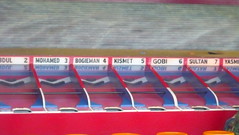
We spent the day in Great Yarmouth with the outlaws. While waiting on the pier I was watching the camel racing arcade. Basically you pay some money and you get a bet on a mechanical camel that races (albeit quite slowly) along the tracks and the winner gets something. Then I realised that the names for each of the camels were meant to be reflective of the desert setting for the game but in piece of latterday Orientalism they came out as:
Mohamed, Abdul, Bogieman, Kismet, Gobi, Sultan, Yasmin and Bagdad.

The world is a very strange place.

Black Power Salute: BBC4


There's another chance to see on iPlayer the BBC documentary about the Mexico '68 Olympics and the events around the black power salutes delivered by Olympic medal winners Tommie Smith and John Carlos and the anger and reaction it provoked.

5.8.08

Publish and Be Damned, 2008

I hadn't been to P&BD for three years - I hadn't realised that it was so long but it moved to Rochelle School a while ago and I'd never been to the new venue. Inside it was hot and very very crowded. What I love about the event is the lack of explanation and any kind of conventional sales material: most people just lay their wares out of a folding table and that's all the explanation you need. At one end of the market there are publications that ape various commercial magazine conventions like a fixed format and logo but usually with unrelentingly non-commercial content (the copy of Mono-Kultur that Yol bought me on the Wu Tang and chess) and at the other the one off artist books, like the map of Hackney with a CD of Ridley Road market traders talking about property prices. In between you get the very fanzine ones that vary from Harry Pye's The Rebel to plain B&W photocopies that look most like Sniffing Glue but with lower production values.

More pics here

My first thoughts on leaving the show were that although it's not that well known an event it is very inclusive and very participatory which has remained pretty much the case since the first fair. The other thing I've been thinking about since then is to wonder what effect the internet has had on self-publishing and in particular the low-end fanzine part of the market. While you'd believe blogging, free webspace and free software to manage your blog would have killed off publishing as a mode of self-expression Publish and Be Damned seems to demonstrate the opposite is actually true. Pushing through the crowds with the their carrier bags full of dead trees and ink or waiting 15 minutes to get to the front of a particularly busy stall you realise that there is something quite special about stuff written, montaged, scrawled, copied and printed on bits of paper that are then (in many cases) lovingly folded in half by hand and stapled especially when it's as good as Calvin Holbrook's Hate Magazine.